E-Applications are registered via a No Touch Registration Process. See SSP Application Process for more information.
If an e-application cannot be registered by the BOT it must be manually registered.
Manual e-Application Registration
e-App Status and Manually Updating an e-App Status
Searching for an e-Application
e-Application Linked to the Wrong Case
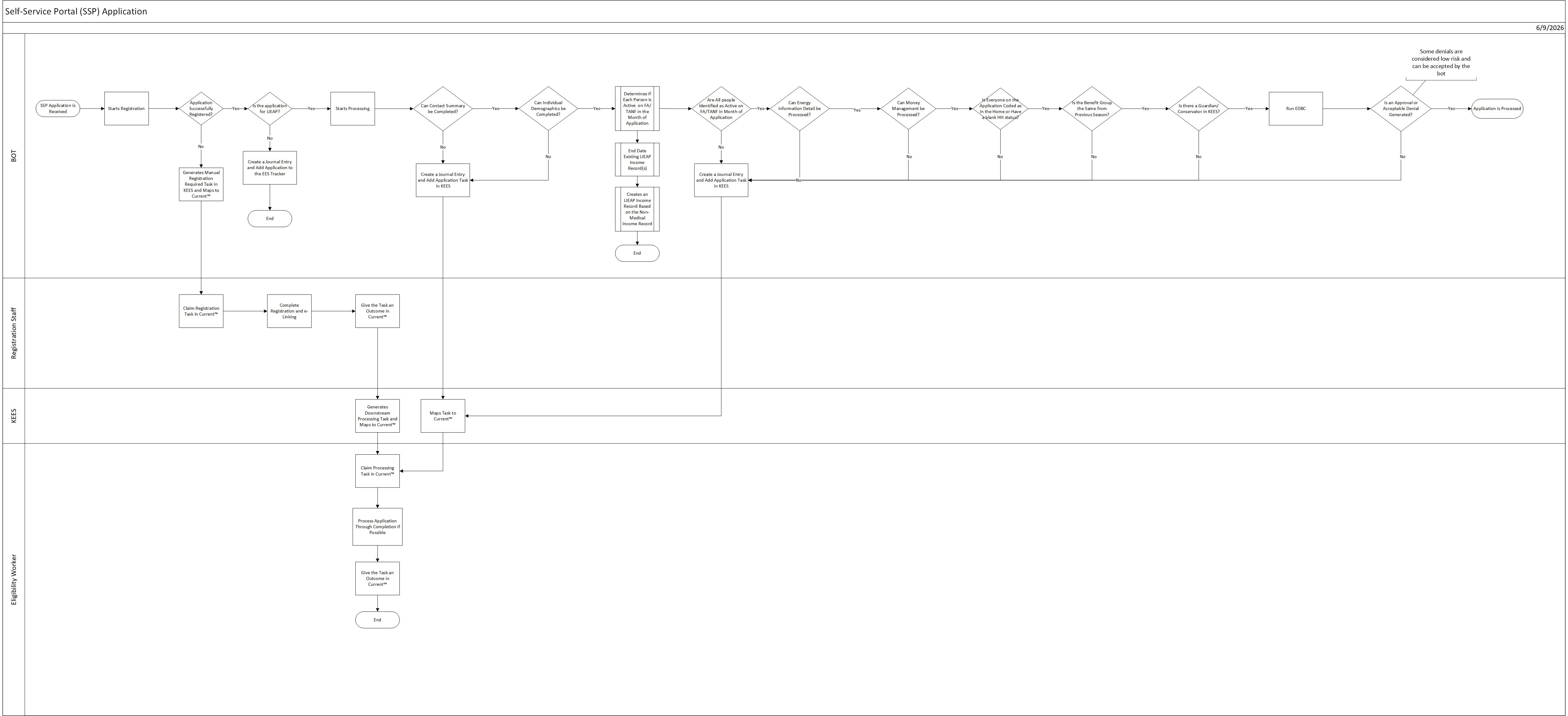
This business process flow shows the high-level steps utilized to process an Application received from the Self-Service Portal (SSP).
When a consumer submits an Application through the SSP, KEES automatically creates and images a PDF version of the Application to the Non-Medical SSP Application document type for Food Assistance, TANF, Child Care, and LIEAP applications.
All applications submitted from the Self-Service Portal (SSP) are prioritized in a list to be registered and processed by a No Touch BOT in KEES. The No Touch BOT determines if there is an existing case number the e-application can be linked to, or if a new case number must be registered. If it is unable to determine if a new case or existing case should be used, the BOT creates a task for registration staff to manually register the application. See No Touch BOT is Unable to Determine What to Do During Registration for additional information.
For Food Assistance, TANF and Child Care Applications:
If the BOT can successfully register the application, then the BOT creates a processing task in KEES that maps to Current™.
For LIEAP Applications:
If the BOT can successfully register the application, then the BOT attempts to process the LIEAP application. When the BOT reaches a point in which it is no longer able to continue processing, the BOT creates a journal entry detailing which step in the process the worker should start with and creates a processing task in KEES that maps to Current™. See No Touch BOT Successfully registers a LIEAP e-Application for additional information.
For LIEAP applications: Creates a LIEAP No Touch Registration Manual task for the LIEAP queue in KEES and maps it to the NL LIEAP Registration queue in Current™.
For Food Assistance, TANF, or Child Care: Creates an EES No-Touch Registration-Manual task for the Administrative queue in KEES and maps it to the NL CORE Registration queue in Current™.
For SUN Bucks: Creates a P-EBT Manual Registration Required task for the Administrative Queue in KEES and maps it to the NL SUNBucks queue in Current™.
Registration Worker:
Claim the fall out registration task from Current™.
Use the task hyperlink in Current™ to navigate to the task in KEES.
Review the task details in KEES to determine where to begin the registration process.
If the e-Application is not linked:
Link and register the application. See e-Application Registration for detailed steps in the KEES User Manual.
Re-index any SSP PDF images from the Non-Medical SSP Application document type to the Application document type utilizing the e-Form. See DCF Imaged Forms Desk Aid for re-indexing supporting documentation.
Give the task an outcome in Current™ and click done. This creates a downstream application task.
If the e-Application is linked:
Validate the program has been applied, reapplied, or rescinded as needed
Validate the address and Worker ID are correct
Re-index any SSP PDF images from the Non-Medical SSP Application document type to the Application document type utilizing the e-Form. See DCF Imaged Forms Desk Aid for re-indexing supporting documentation.
Give the task an outcome in Current™ and click done. This creates a downstream application task.
Eligibility Worker:
Claim the task from Current™.
Navigate to the case in KEES
Accept or reject SSP data by completing Data Acceptance and process the Application. This includes the collateral contact process and printing electronic supporting documentation to Perceptive Content in the Case-No Task basket.
Give the task an outcome in Current™ and click done.
The No Touch BOT attempts to process the LIEAP application by acting on each LIEAP data collection page. The No Touch BOT processes the LIEAP application in the following order:
Contact Summary Page
Accepts any address changes except for Foster Care children.
If the Physical address is out of state, the BOT stops processing.
Individual demographics
The BOT ignores changes to first name, SSN or Date of Birth.
Accepts changes to race/ethnicity, email address and phone number.
If there is a change to the last name that is not identified as a likely typo, the BOT stops processing.
Income
The BOT compares the income reported on the application to income known to any Active Food Assistance, TANF or Child Care programs.
If the application has a change in income the BOT stops processing. A change in income is defined as there being more than a 20% difference between known income and the application.
If there is no change in income, the BOT creates a LIEAP income record of the same type and amount as on the Active Food Assistance, TANF or Child Care program.
If there is no income reported on the application and no income on the Active Food Assistance, TANF, or Child Care program it is considered verification of no income.
If there is no Active Food Assistance, TANF, or Child Care program the BOT stops processing.
Energy Information Detail
If the applicant reports a change in dwelling type, fuel source, or how the bill should be split, the BOT stops processing.
Money Management
The BOT compares the vendor listed on the application to the existing vendor from a previous LIEAP season. The BOT has been taught to compare common names (i.e. if the application says KSGAS, it recognizes that vendor as One Gas).
If the application reports a new vendor, or if the vendor or service is no longer Active, the BOT stops processing.
Compare Household Status
The BOT checks to see if all people being applied for have a Household Status of “In the Home” or blank. If not, the BOT stops processing.
Compare Benefit Group
The BOT compares the Benefit Group size to the last time a LIEAP application was processed. If there is a difference, the BOT stops processing.
Check for Guardian/Conservator
The BOT checks for an existing Guardian or Conservator. If one exists, the BOT stops processing.
Run EDBC
The BOT Saves and Accepts any EDBC results that end in approval.
The BOT reviews any denials and only Saves and Accepts denials that have been identified as low risk. If the denial cannot be saved, the BOT stops processing.
Eligibility Worker:
Claim the fall out processing task from Current™.
Go into the context of the case and review the Journal for instructions on where to start processing.
Process the e-Application beginning on the first page that was not completed by the BOT using first contact resolution. See the BPM Handbook for more information.
Print all electronic documentation to Perceptive Content utilizing ImageNow Printer in the Case No-Task basket.
Give the task an outcome in Current™ and click done.
If the consumer is homeless, set the mailing address to General Delivery. When entering a physical address, enter ‘Homeless’ on line 1, and then use the general delivery information for city, zip code, and state.
Shared Data is when a data collection page in KEES has one data field used by both DCF and KDHE to collect information and determine eligibility. Communication between agencies is required when certain data is created, updated or changed in KEES.
When the case you are processing has multiple e-Apps linked to it that are in Pending or In Progress status, EDBC only updates the most current dated e-App to Accepted. The remaining older e-Apps will remain in a Pending or In Progress status. Workers should manually update the older linked application’s status to Processed by Worker. See e-App Status and Manually Updating an e-App Status for detailed steps.
e-Applications are queued to be registered by the No Touch BOT by order of priority. For LIEAP that includes 18-hour, 48-hour, no priority. For Food Assistance that includes expedited or non-expedited. Within each priority they are added in the order of which they were submitted from the SSP.
There are No Touch BOTs assigned to LIEAP, SUN Bucks, and Food Assistance/TANF/Child Care. Priority is managed within that program designation.
The No Touch BOT processes all applications submitted prior to 5pm each day and will continue working until it has processed all applications in the business day or until KEES availability ends for the day. For example, if KEES availability is 6am to 8pm then the BOT will run if there are applications to be registered. If it is caught up to same day registration, then it will stop prior to 8pm in this scenario once it has completed all applications received prior to 5pm that day.